Web Article
Choosing the Right AI Agent Memory Strategy: A Decision-Tree Approach
Created on July 13, 2026
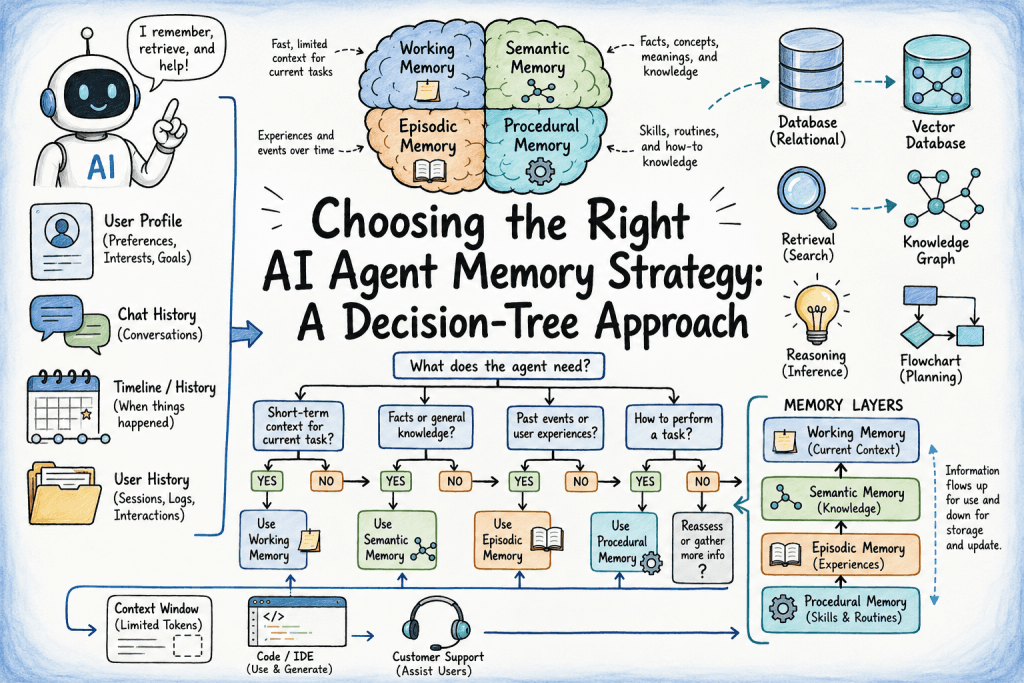
The article "Choosing the Right AI Agent Memory Strategy: A Decision-Tree Approach" provides a structured method for designing effective memory systems in AI agents. It emphasizes that treating all information uniformly can lead to memory problems, and instead advocates for differentiating between four key memory types: working, semantic, episodic, and procedural memory. Each type serves a distinct purpose; for instance, working memory handles current conversation within a token budget, while semantic memory stores stable, reusable information.
The core of the article is a five-question decision tree that guides developers in classifying specific categories of information an AI agent handles. By running through this tree for each information category (e.g., a support agent's "current ticket" versus "complaint history"), developers can determine how long the information should persist, whether it's a stable fact or an event, how it will be retrieved, and if it represents a reusable behavior. This approach helps in building a comprehensive memory architecture that integrates various memory layers effectively.
The article also highlights common pitfalls in memory implementation, such as issues with persistence, scope, fact vs. event classification, and retrieval methods. It provides guidance on how to avoid or fix these problems, ensuring that the chosen memory strategy enhances the AI agent's performance and efficiency. Real-world examples, like customer support and coding agents, are used to illustrate how different memory layers can be combined into a robust architecture.
Summarized using AI, subject to mistakes
Loading...